
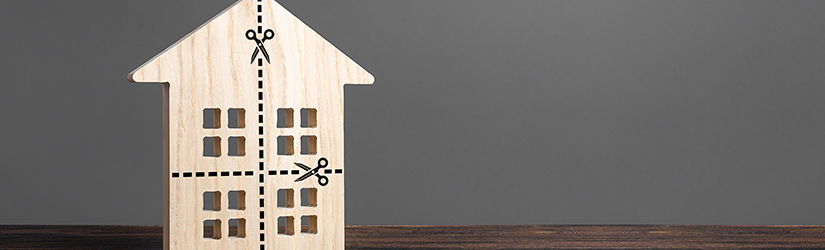
The term co-ownership refers to the abstract division established over a property when it belongs to several people, all of whom have ownership rights. Therefore, co-ownership exists when a property is purchased by multiple individuals.
However, this shared ownership does not refer to a specific physical part of the property, but rather to an abstract share or percentage of it.
Causes of the dissolution of co-ownership
The dissolution of co-ownership can take place when any of the owners requests the division. It generally occurs for four main reasons:
- Consolidation: When one of the owners acquires the shares of the others, or when these shares are transferred to a third party.
- Loss or destruction of the jointly owned property.
- Renunciation of ownership.
- Division of the common property.
However, there may also be situations in which dissolution cannot be carried out. This may be due to:
- The existence of an agreement (for up to 10 years) to maintain the co-ownership
- The indivisible nature of the property.
How is the dissolution of co-ownership carried out?
When carrying out the dissolution, it is important to consider whether the asset is divisible or indivisible, and whether there is agreement among the co-owners:
If the asset is divisible and there is agreement: The process consists of dividing the property and assigning each co-owner their share, or selling it to a third party and distributing the proceeds.
If the asset is indivisible and there is agreement: The property is awarded to one co-owner, who must compensate the others, or the property is sold to distribute the proceeds.
If there is no agreement: Whether the asset is divisible or not, the process becomes a judicial procedure for the division of common property.