
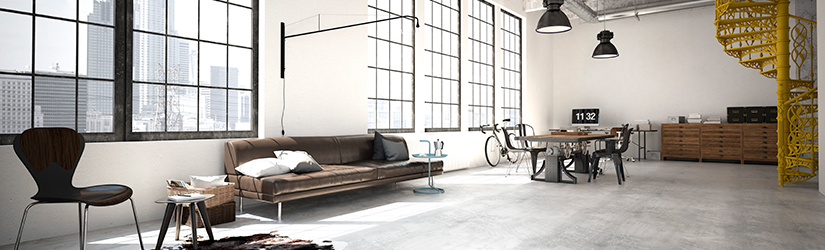
A loft apartment is characterised by having very few internal divisions, which means it is usually very spacious and comfortable. Because of its origins, this type of apartment has a number of distinctive features that set it apart from other homes.
History and origin of lofts
To understand the features that define what a loft is, we need to go back to its origins, which also explain why the industrial style is so closely associated with this type of property.
This type of home emerged in the mid-20th century, particularly in major US cities such as New York. The economic recession following the Second World War led to the closure of many factories and, therefore, increased the number of vacant spaces that could be converted for residential use, although with very distinctive characteristics.
Many young students and professionals took advantage of this appealing property opportunity and moved into the empty factories, which had now been turned into open-plan homes, far removed from conventional architectural styles.
They proved to be ideal spaces for both living and working, thanks to their large rooms, high ceilings, impressive natural light and, at that time, very affordable prices.
Little by little, the loft model became associated with high-end homes. Interior design trends gradually began to move beyond the dominance of the industrial style in these spaces. Today, it is possible to find remarkable lofts ranging from classic and Nordic to rustic, minimalist and many other styles.
Main characteristics of a loft
- Open-plan spaces: there are virtually no divisions between the different areas that make up the home and, where they do exist, they are generally not full walls enclosing the room completely, with columns or sliding doors tending to be used instead.
- High ceilings and bright spaces: in general, these homes tend to feature high ceilings and large windows that allow plenty of natural light in, making brightness one of their greatest advantages.
- Industrial style: because of the context in which these apartments first emerged, industrial style often takes centre stage in the interior design, avoiding overcrowded rooms and using natural materials such as brick or metal. Although industrial style is directly associated with this type of home, lofts can now also be found with Nordic, Mediterranean or even rustic décor.
Differences between a loft and a studio
The features of lofts can sometimes be compared with, or confused with, those of studio flats. First of all, although both types of home tend to have spacious, open-plan interiors, lofts generally offer more space because they are usually larger than studios, which are based on the concept of compact living and are characterised by having only one or two rooms.
On the other hand, price is also a key factor when distinguishing between a loft and a studio. In general, studios tend to be more affordable, as loft prices are usually considerably higher.
Advantages of living in a loft
Despite having been around for almost a century, living in a loft remains a unique experience and completely different from living in any other type of home. That is why they continue to be in such high demand.
Some of the main advantages of living in a loft are listed below:
- The sense of space is second to none. It is the open-plan concept taken to its fullest expression.
- The large windows typically found in a loft allow abundant natural light to enter, making these properties more welcoming, efficient and sustainable.
- That same arrangement of numerous and impressive windows improves ventilation and air circulation better than in most other properties.
- We should also add the decorative freedom a loft offers, accommodating a wide variety of styles with endless possibilities, thanks precisely to the generous space available.
Disadvantages of living in a loft
A loft is not for everyone. Like any other type of home, it has its disadvantages, and these are worth bearing in mind:
- It is more difficult to achieve privacy, as the open-plan layout does away with walls in areas that would usually have them, such as the bedroom or a home office.
- In a loft, sounds tend to carry more easily, as there are no architectural barriers to block them. Harmony inside the space is just as important as good insulation from outside noise.
- Depending on its location, a loft can present a real challenge in terms of climate control, both when heating the space during colder periods and when keeping it cool in the warmer months.
Frequently asked questions about lofts
Is it expensive to buy or rent a loft?
Despite their humble and even somewhat bohemian origins, living in a loft is now associated with high-end living, so buying or renting one is generally more expensive than other types of home.
That said, it is still a flat and is usually located in an urban centre, so it may still be a more affordable option than single-family homes or detached houses. Everything depends on the specific property, its location and, of course, the features of the development itself.
How can I decorate a loft efficiently?
A loft can accommodate all kinds of interior design styles. The most common is industrial, but you can also explore other options and achieve striking results.
The important thing in a loft is to prioritise order. Its large spaces allow for an organised arrangement of all kinds of furniture and accessories. Achieving a balance between them is fairly straightforward, and you are sure to find a unifying style that suits your decorative preferences.
What types of loft are there depending on design or location?
There is a wide variety of loft types if we distinguish them according to their design or even their location (or the style they aim to recreate). These are the best known:
- Classic loft: industrial in style and still based on the conversion of former warehouses and factories.
- Duplex loft: arranged over two levels, with the upper one usually used as the sleeping area.
- Work loft: designed mainly for working, although it may also include sleeping areas.
- Minimalist loft: with striking interior design that reduces everything to the essentials.
- Mediterranean loft: an adaptation of these spaces to a very bright style with bold colours.
- Rustic loft: transforms the industrial style into a tribute to the connection with nature and rural living.