
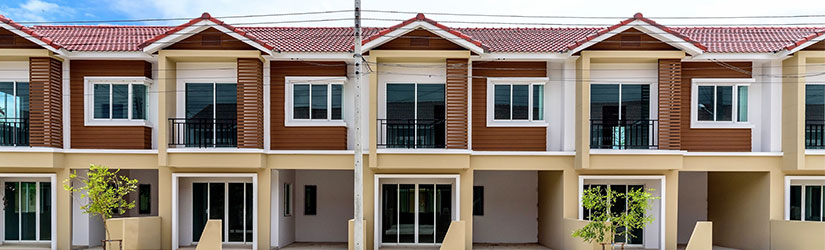
A terraced house, also commonly referred to simply as a terrace, is a single-family home which, although built as an independent property, shares boundary walls with the adjoining homes, in other words, it shares walls with the houses on either side. In general, a terraced house usually has a small garden either at the front or rear of the property (depending on the type of construction) or alternatively an outdoor patio or terraces.
Terraced houses are classified as follows according to the number of floors they have:
- Simplex: single-storey terraced house
- Duplex: two-storey terraced house
- Triplex: three-storey terraced house
Advantages of terraced houses
Some of the advantages of terraced houses are as follows:
- Price. The price is usually more accessible or affordable than that of a detached single-family home.
- Peace and quiet. Terraced houses are usually located in residential areas on the outskirts of cities or in peripheral areas away from the hustle and bustle, and therefore offer peace and quiet. In addition, they are often close to green spaces or parks.
- Convenience. In most cases, developments of terraced houses are close to amenities such as schools, supermarkets and leisure facilities.
- Space. The usable floor area of a terraced house is usually greater than that of a flat and, therefore, the available space, although distributed over several floors, is more generous.
- Outdoor area and garage. Terraced houses have their own outdoor area, whether a garden or patio, as well as a garage space.
- Community living. A terraced house allows the owner to live in a single-family home while also enjoying the advantages of living within a community.