
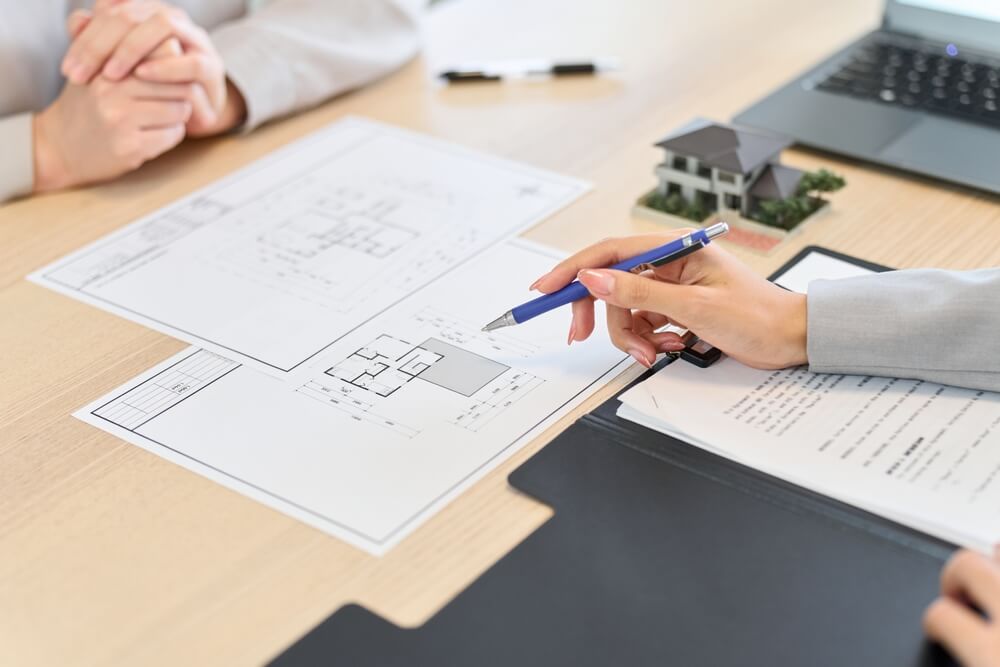
A building permit is an administrative authorization that must be requested from the local council of the municipality where the work will take place. It is essential for carrying out any type of construction, renovation, rehabilitation, or demolition. Once the corresponding fees and charges are paid, it allows work to begin in accordance with the plans and specifications submitted with the application. You may also have heard of a declaration of responsibility, which is related to the application process for certain types of work.
This is a mandatory requirement that must always be obtained before starting any works (major or minor) to ensure their legality.
This permit has a specific validity period, typically one year to start the works and three years to complete them, although it can be extended if necessary. The start date of the works must always be specified.
It is also important to note that a building permit is not only required for new constructions, major renovations, restorations, or demolitions (major works permits), but also applies to minor works such as refurbishments or home improvements.
When is a building permit required?
A building permit is required whenever any type of construction, renovation, demolition, or refurbishment is carried out.
Each local council regulates the procedure for applying for a permit through its own ordinances, which can usually be consulted on the council’s website. In general, the process for applying for a building permit is as follows:
- Preparation of a technical project: This must be carried out by a qualified architect or technical specialist and details the characteristics of the planned work.
- Submission of the application: A permit application must be submitted along with the technical project and all required documentation.
- Payment of fees: These are set by each local council for processing the permit.
- Review and approval: Municipal authorities review the application and may carry out inspections to ensure compliance with local regulations before granting the permit.
If you have any doubts about which activities require a building permit or the procedure involved, it is advisable to consult your local council.
How much does a building permit cost?
One of the most common questions is how much a building permit costs. The total cost depends on the fees set by each local council.
Fees are calculated based on the type of work, according to established modules, each with a different rate. These are known as “Urban Planning Service Fees” (TPSU), and their details are available at local councils or on their websites.
Once the permit is granted, you must also pay the Construction, Installations, and Works Tax (ICIO), which ranges between 2% and 4% of the total project budget.
Additionally, there may be a fee for the private use of public land. This applies if public space is used during the works (for example, scaffolding, containers, or machinery). Like other fees, this may vary depending on the location and type of street.
It is important to note that VAT is not included when calculating these taxes and fees.
Consequences of carrying out works without a permit
Carrying out works without a permit generally results in penalties, which vary depending on the autonomous community.
In some cases, fines are calculated as a percentage of the total cost of the work (sometimes up to 200%), while in others they are fixed amounts (ranging from around €150 to as much as €3 million).
Given the cost of permits and the severity of potential penalties, it is highly advisable to comply with current regulations.
Additionally, depending on the type of work, the local council may require demolition and reconstruction in accordance with legal standards.
Frequently asked questions about building permits
Applying for a building permit at home raises several questions; these are some of the most common ones among homeowners:
How do you apply for a building permit?
The documentation required may vary depending on local regulations, but generally includes:
- Technical project (including a descriptive report, drawings, and detailed budget).
- Work plan (execution phases).
- Photographs of the current state of the property.
For minor works permits, it is often sufficient to submit a description of the planned work along with a budget estimate.
Can I modify the project after obtaining the building permit?
Yes, but you must apply for a modification of the permit based on the proposed changes. You will need to submit updated documentation reflecting the new project details.